


High Permeability Nanocrystalline Amorphous Alloy C Shape Core
Oct 14, 2025
Leave a message
Nanocrystalline Amorphous Alloy C Core
A nanocrystalline amorphous alloy C core is a C-shaped magnetic core made from a rapidly solidified, amorphous metal alloy that is later annealed to create a nanocrystalline structure. These cores are used in electrical applications like transformers and inductors because they offer superior magnetic properties, such as high permeability, high saturation flux density, and low core loss, which lead to smaller, more energy-efficient designs.

Nanocrystalline Amorphous C Core Feature
Ultra-Low Core Loss
Demonstrates significantly lower loss characteristics than conventional silicon steel and amorphous alloys, especially suitable for high-frequency, high-power-density applications.
Excellent Temperature Stability
Maintains stable magnetic performance across a wide temperature range, with minimal performance degradation in high-temperature environments.
High Saturation Flux Density
Offers higher saturation flux density compared to traditional amorphous materials, making it ideal for high-power applications.
Nanocrystalline Amorphous C Core Application
- High-power high-frequency transformers
- Key components in industrial frequency converters
- Renewable energy generation systems
- Specialized power supply equipment
- Rail transit power systems
What Is The Difference Between Amorphous And Nanocrystalline Cores
Amorphous and nanocrystalline are two types of magnetic core materials that are commonly used in power transformers and other electrical equipment. Both these materials have unique properties that make them suitable for specific applications.
Amorphous cores are made of a metallic glass alloy, which is a non-crystalline solid material. The atoms in the alloy are randomly arranged, unlike in crystalline materials where atoms arrange themselves in a specific pattern. This random arrangement of atoms results in unique magnetic properties that make amorphous cores suitable for high-frequency applications.
Nanocrystalline cores, on the other hand, are made of a crystalline material with extremely small grain sizes, typically less than 100 nanometers. This small grain size results in unique magnetic properties that make them suitable for low-frequency applications.
One of the key differences between amorphous and nanocrystalline cores is their magnetic permeability. Magnetic permeability is a measure of how easily a material can be magnetized. Amorphous cores have higher magnetic permeability than nanocrystalline cores, which means they are easier to magnetize. This makes amorphous cores suitable for high-frequency applications where fast switching speeds are required.
Nanocrystalline cores, on the other hand, have lower magnetic permeability, which means they require stronger magnetic fields to achieve the same level of magnetization as amorphous cores. This makes nanocrystalline cores suitable for low-frequency applications where slower switching speeds are acceptable.
Another key difference between amorphous and nanocrystalline cores is their magnetic losses. Magnetic losses refer to the amount of energy that is lost as heat when the core is magnetized and demagnetized. Amorphous cores have lower magnetic losses than nanocrystalline cores, which means they are more energy-efficient and generate less heat.
Nanocrystalline cores, on the other hand, have higher magnetic losses, which means they generate more heat and are less energy-efficient. However, newer nanocrystalline materials have been developed that have lower losses than traditional nanocrystalline materials.
Another difference between amorphous and nanocrystalline cores is their saturation flux density. Saturation flux density is a measure of how much magnetic field a material can withstand before it becomes saturated and can no longer be magnetized. Amorphous cores have a lower saturation flux density than nanocrystalline cores, which means they are more susceptible to saturation at higher magnetic fields.
Nanocrystalline cores, on the other hand, have a higher saturation flux density, which means they can withstand higher magnetic fields without saturating. This makes them suitable for applications where higher magnetic fields are required.
Both amorphous and nanocrystalline cores have their strengths and weaknesses, and the choice of material depends on the specific application requirements. Amorphous cores are ideal for high-frequency applications where low losses and fast switching speeds are important. Nanocrystalline cores are ideal for low-frequency applications where higher flux densities and lower losses are important.
The key differences between amorphous and nanocrystalline cores are their magnetic permeability, magnetic losses, saturation flux density, and suitability for specific applications. Understanding these differences is important when choosing a magnetic core material for a specific application.
C Core specification
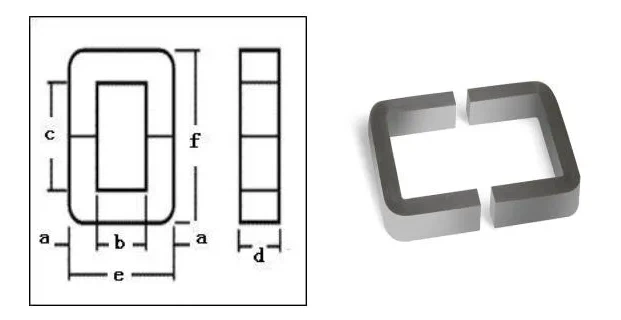
| Core Build | Window Width | Core Height | Core Width | Core Length | |||||
| a(mm) | ± | b(mm) | c(mm) | d(mm) | ± | e(mm) | ± | f(mm) | ± |
| 9 | 0.5 | 10 | 32.8 | 15 | 0.5 | 28 | 1 | 50.8 | 1.25 |
| 10 | 0.5 | 11 | 33 | 20 | 0.5 | 31 | 1 | 53 | 2 |
| 11 | 0.5 | 13 | 30 | 20 | 0.5 | 35 | 1 | 52 | 2 |
| 11 | 0.5 | 13 | 40 | 20 | 0.5 | 35 | 1 | 62 | 2 |
| 11 | 0.5 | 13 | 40 | 25 | 0.5 | 35 | 1 | 62 | 2 |
| 11 | 0.8 | 13 | 50 | 25 | 0.5 | 35 | 1 | 72 | 2 |
| 11 | 0.8 | 13 | 50 | 30 | 0.5 | 35 | 1 | 72 | 2 |
| 13 | 0.8 | 15 | 56 | 25 | 0.5 | 41 | 1 | 82 | 2 |
| 13 | 0.8 | 15 | 56 | 30 | 0.5 | 41 | 1 | 82 | 2 |
| 13 | 0.8 | 15 | 56 | 35 | 0.5 | 41 | 1 | 82 | 2 |
| 16 | 0.8 | 20 | 70 | 25 | 0.5 | 52 | 1 | 102 | 3 |
| 16 | 1 | 20 | 70 | 30 | 0.5 | 52 | 1 | 102 | 3 |
| 16 | 1 | 20 | 70 | 40 | 0.5 | 52 | 1 | 102 | 3 |
| 16 | 1 | 20 | 70 | 45 | 1 | 52 | 1 | 102 | 3 |
| 19 | 1 | 25 | 83 | 35 | 1 | 63 | 1 | 121 | 3 |
| 19 | 1 | 25 | 83 | 40 | 1 | 63 | 1 | 121 | 3 |
| 19 | 1 | 25 | 83 | 50 | 1 | 63 | 1 | 121 | 3 |
| 19 | 1 | 25 | 90 | 60 | 1 | 63 | 1 | 128 | 3 |
| 22 | 1 | 35 | 85 | 50 | 1 | 79 | 1 | 129 | 4 |
| 22 | 1 | 35 | 85 | 65 | 1 | 79 | 1 | 129 | 4 |
| 25 | 1 | 40 | 85 | 55 | 1 | 90 | 1 | 135 | 4 |
| 25 | 1 | 40 | 85 | 70 | 1 | 90 | 1 | 135 | 4 |
| 25 | 1 | 40 | 85 | 85 | 1.5 | 90 | 1 | 135 | 4 |
| 30 | 1 | 40 | 85 | 85 | 1.5 | 100 | 1 | 155 | 4 |
| 33 | 1 | 40 | 105 | 85 | 1.5 | 106 | 1 | 171 | 5 |
| Note: Additional sizes can be customized to meet specific customer requirements. | |||||||||
GNEE Featured Products
Gnee provides premium iron cores to the world. Our cores can be selected in a wide range of materials, shapes, applications, manufacturing techniques, etc., to meet customers' diverse demands. Explore our wide product range now~



Manufacturing Process

1. Raw Material Sourcing

2. Slitting

3. Punching

4. Laminating

5. Core Forming

6. testing
GNEE EC
Founded in 2008 and located in Anyang in China, Gnee Electric is a high-tech enterprise specializing in researching and manufacturing iron core products.
The company currently occupies over 20,000 square meters and employs more than 200 people, including over 80 professionals. After more than 18 years of development, we have built our own magnetic material production base and independently develope, produce, and sell various kinds of iron cores. The common types include silicon steel cores, motor cores, transformer cores, toroidal iron cores, special-shaped cores, custom cores, and others. Our cores are widely applied in different sectors including transformers, motors, mutual inductors, voltage stabilizers, welding machines, magnetic amplifiers, and instrumentation, providing diverse core solutions to global customers.

30+
Types of Products
18k+
Happy Clients
Why Choose GNEE EC?
GNEE EC was founded in 2008, which is a National High-tech Enterprise & Famous Brand Enterprise in China, developing into a professional manufacturer and supplier of high-quality iron cores.
18+
Over 18 years of success in the iron core industry;
National High-tech Enterprise & Famous Brand Enterprises in China;
200+
Over 200 employees;
The R&D team has more than 80 experienced engineers and the production team has more than 100 skilled staffs;
35+
Annual turnover up to 35 million dollor per year;
Owns many sets of highly automatic winding, annealing, and assembling machines;
1,000+
Over 1000 customers in domestic and overseas markets;
core Products are exported to more than 70 countries in the world;
Gnee Iron Core Factory Overview


Meet Our Sales Manager
"The Core of the Iron Core, the Power of Leadership" - See Our Great Decision-Makers Deeply Engaged in the Magnetic Materials Industry.

Edison Zhang
CEO

Kelly Zhang
General Manager

Alex Cao
Sales Manager
Industries Served

Automobile Industry

New Energy


Transformer Applications

Our Mission
Strive To Create world-class Iron core brand
With 18 Years of industry experience, we focus on the research, development, and manufacturing of high-quality iron cores for electricity, industrial control, new energy, and automotive markets