


About Amorphous Cores
Oct 15, 2025
Leave a message
About Amorphous Cores
Amorphous Cores are made of metallic glass metallic without any well-defined crystalline form. Depending on their amorphous structure, these cores offer improved electric conductivity, efficient functioning, higher permeability, and increased magnetic density over a diverse range of temperatures usually not tolerated by other types of cores due to their low Curie temperatures.
These cores are made from the process of solidification of the molted metal. Amorphous Cores are actually soft magnetic materials boasting stacks and stacks of silicon steel lamination. Their notable properties include high electric resistivity, relatively improved mechanical characteristics, and excellent magnetic and electromagnetic properties.
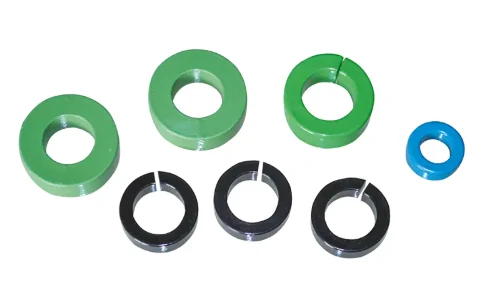
Moreover, you can find these cores in multiple different types, including E-core, C-core, Amorphous Toroidal core, Shell core, Cut core, Block core, Planner core, U-core, Disc core, T core, and many more, mainly distinct in shape. This factor alone can contribute to changing the properties of the core, making some types more suitable for one application and some for another.
Why Use Amorphous Cores?
Reduced Core Loss
Core losses are referred to as the dissipation of energy in the form of heat when the core is exposed to alternating magnetic fields. Amorphous Cores are found to have relatively lower core loss depending on their structural properties. However, you can use them for optimal energy efficiency, especially in applications involving continuous processing.
Broad Frequency Range
Unlike the typical magnetic or crystalline cores, these have a broad frequency range. They aren't limited to the specific frequency bands. These are the main reasons why amorphous crystalline cores are considered versatile in multiple applications.
Reduced Carbon Dioxide Emission
According to the analysis shared by the United Nations, transformers alone contribute to the overall carbon dioxide emission significantly. Their fair share in the emission is around 730 million tons per year.
Owing to the energy efficiency of the Amorphous Cores, you can significantly reduce your industry's carbon footprint by minimizing the production and emission of carbon dioxide.
Noteworthy Initial Permeability
Another important aspect is the considerable initial permeability offered by the Amorphous Cores. They are pretty sensitive to mere magnetic field changes. This property is helpful in inductors, sensors, and transformers where swift magnetic flux changes must be accommodated.
10 Most Common Applications of Amorphous Cores
Amorphous Cores are made to be used in diverse applications owing to their low connectivity, low loss, and higher vulnerability. Some of the most common applications of their usage include:
1. Audio Systems
Amplifiers are undoubtedly a key component of any audio system, and Amorphous Cores, in turn, are important components of amplifiers. These are mainly involved in amping up the received signal and submitting it to the speaker or any other output source. By amping up, we mean increasing the signal amplitude, so you can observe a significant increase between input and output signal amplification.
How much an amplifier amplifies the signals depends entirely on the gain, i.e., the ratio of output specifications, like current and voltage, to that of the input.
2. Power Supplies
Soft magnetic material is usually preferred in power supplies. A power supply is a source electronic device that transforms any form of energy into an electrical one and supplies it to an electric load as output. Its function revolves around converting the received energy form, mostly the current itself, into the required frequency, current, and voltage to power the entire load side.
3. Medical Equipment
When it comes to medical equipment, safety stands as a key factor to consider. That said, amorphous materials are a noteworthy combination with Toroidal core, C-core, or Black core.
4. Magnetic Sensors
These cores are also used in magnetic sensors like position, magnetic field, and current. Their high sensitivity to any magnetic field change around them makes them ideal for the purpose.
5. Transformers
Another important application of the Amorphous Toroidal core is distribution and power transformers. With them, you get to enjoy higher efficiency and minimized core loss.
On the other hand, typical solutions, like silicone steel cores, won't only cost you a lot but also have reduced efficiency and increased power loss due to heat generation. System heating remains another incurable issue.
6. Current Transformers
You can also use these cores in current transformers to precisely measure the distribution systems' electric currents. Their extent of accuracy and the linearity of performance over increased and decreased temperature makes them suitable for this application.
7. Magnetic Shielding
Telecommunication equipment and medical devices need magnetic shielding for safe and accurate working. Amorphous Cores can provide this shield against electromagnetic or radiofrequency interferences.
8. Noise Filtering
Noise can be disturbing or disrupting, affecting the output signal and reducing its reception on the receiver side. However, with the noise filtering power of the amorphous chokers installed in chokers and inductors, you can ensure to get rid of these unwanted disturbances.
9. EV Charging
Electric vehicles will take over the world in the coming years. Every vehicle will get replaced by its EV version, and so will the need for EV charging will arise. What sets them apart from other cores is their ability to minimize the core losses and save as much power as possible.
10. Pulse Transformer
High-speed and in-time communications demand precise time management with minimum disturbance and pulse shaping. This task can be done well by the Amorphous Cores, which ensure swift transmission and resistance against distortion.
Amorphous ring Cores specification

| Magnetic core size(mm) | Protective box size(mm) | Effective cross-sectional area Ae(mm2) | Magnetic path length Ie(mm) | Maximum DC overcurrent class (A) |
||||||
| id | od | ht | ID | OD | HT | |||||
| 14 | 19 | 6.5 | 12 | 22 | 8 | 11.86 | 51.81 | 20 | ||
| 14 | 20 | 10 | 12 | 22.3 | 11.4 | 29.68 | 52.29 | 40 | ||
| 16 | 21 | 10 | 15 | 24 | 12.3 | 24.85 | 57.41 | 60 | ||
| 16 | 23 | 8 | 15 | 24 | 9.7 | 20.44 | 61.23 | 60 | ||
| 16 | 23 | 10 | 15 | 24 | 12.3 | 34.62 | 59.92 | 60 | ||
| 17 | 22 | 10 | 15.3 | 24.4 | 12.3 | 24.86 | 60.59 | 60 | ||
| 17 | 21 | 8 | 15.3 | 24 | 9.7 | 25.56 | 60.67 | 60 | ||
| 17 | 23 | 8 | 15.3 | 24.4 | 9.7 | 26.89 | 61.34 | 60 | ||
| 18 | 23 | 10 | 16.4 | 24.4 | 12.3 | 29.78 | 60.38 | 70 | ||
| 18 | 24 | 9 | 16.4 | 25 | 11.2 | 34.78 | 60.89 | 70 | ||
| 18 | 25 | 10 | 16.4 | 25.9 | 12.3 | 37.97 | 64.56 | 70 | ||
| 19 | 24 | 9 | 17.3 | 25 | 11.2 | 40.39 | 65.32 | 80 | ||
| 19 | 25 | 10 | 17.3 | 26 | 12.3 | 39.42 | 62.31 | 80 | ||
| 19 | 26 | 10 | 17.3 | 27.3 | 12.3 | 48.32 | 69.56 | 80 | ||
| 20 | 25 | 10 | 18.5 | 26.3 | 12.3 | 39.29 | 70.32 | 90 | ||
| 20 | 28 | 10 | 18.5 | 29 | 12.3 | 45.76 | 73.88 | 90 | ||
| 20 | 32 | 10 | 18.5 | 32.3 | 12.3 | 58.91 | 78.75 | 90 | ||
| 21 | 29 | 10 | 18.2 | 31.3 | 12.3 | 39.65 | 77.19 | 100 | ||
| 21 | 26 | 8 | 18.3 | 27.4 | 9.7 | 46.54 | 78.32 | 100 | ||
| 21 | 28 | 10 | 18.3 | 30 | 12.3 | 50.39 | 77.45 | 100 | ||
| 22 | 28 | 10 | 20.5 | 30 | 12.3 | 49.32 | 79.89 | 120 | ||
| 22 | 32 | 10 | 20.5 | 33.4 | 12.3 | 43.58 | 73.43 | 120 | ||
| 23 | 32 | 10 | 21.3 | 33.4 | 12.3 | 44.56 | 74.56 | 120 | ||
GNEE Featured Products
Gnee provides premium iron cores to the world. Our cores can be selected in a wide range of materials, shapes, applications, manufacturing techniques, etc., to meet customers' diverse demands. Explore our wide product range now~



Manufacturing Process

1. Raw Material Sourcing

2. Slitting

3. Punching

4. Laminating

5. Core Forming

6. testing
GNEE New Material
Founded in 2008 and located in Anyang in China, GNEE New Material is a high-tech enterprise specializing in researching and manufacturing iron core products.
The company currently occupies over 20,000 square meters and employs more than 200 people, including over 80 professionals. After more than 18 years of development, we have built our own magnetic material production base and independently develope, produce, and sell various kinds of iron cores. The common types include silicon steel cores, motor cores, transformer cores, toroidal iron cores, special-shaped cores, custom cores, and others. Our cores are widely applied in different sectors including transformers, motors, mutual inductors, voltage stabilizers, welding machines, magnetic amplifiers, and instrumentation, providing diverse core solutions to global customers.

30+
Types of Products
18k+
Happy Clients
Why Choose GNEE New Material?
GNEE New Material was founded in 2008, which is a National High-tech Enterprise & Famous Brand Enterprise in China, developing into a professional manufacturer and supplier of high-quality iron cores.
18+
Over 18 years of success in the iron core industry;
National High-tech Enterprise & Famous Brand Enterprises in China;
200+
Over 200 employees;
The R&D team has more than 80 experienced engineers and the production team has more than 100 skilled staffs;
35+
Annual turnover up to 35 million dollor per year;
Owns many sets of highly automatic winding, annealing, and assembling machines;
1,000+
Over 1000 customers in domestic and overseas markets;
core Products are exported to more than 70 countries in the world;
GNEE New Material Factory Overview


Meet Our Sales Manager
"The Core of the Iron Core, the Power of Leadership" - See Our Great Decision-Makers Deeply Engaged in the Magnetic Materials Industry.

Edison Zhang
CEO

Kelly Zhang
General Manager

Alex Cao
Sales Manager
Industries Served

Automobile Industry

New Energy


Transformer Applications

Our Mission
Strive To Create world-class Iron core brand
With 18 Years of industry experience, we focus on the research, development, and manufacturing of high-quality iron cores for electricity, industrial control, new energy, and automotive markets