


1K107 Nanocrystalline Square Iron Core for Efficient Transformers
Oct 27, 2025
Leave a message
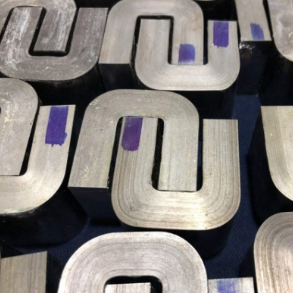
Nanocrystalline square iron core is a soft magnetic component with a square cross-section made from nanocrystalline alloy ribbons through specific winding, pressing, and annealing processes. It inherits the core advantages of nanocrystalline materials-low iron loss and high magnetic permeability-while its square structure adapts to the rectangular winding design of transformers, reactors, and other equipment. This enables it to deliver dual value of "space matching + high energy efficiency" in medium-high frequency power electronic devices.

Core Characteristics of Nanocrystalline Square Iron Core
The characteristics of nanocrystalline square iron core stem from the synergy between "material performance" and "square structure". It not only retains the advantages of nanocrystalline materials but also solves space and assembly problems in practical applications through structural optimization.
1. Material Level: Inheriting High-Efficiency Magnetic Performance of Nanocrystals
Extremely Low Iron Loss: In medium-high frequency scenarios (e.g., 50kHz-200kHz), the iron loss (P₁/100k) is only 15-30W/kg, far lower than that of silicon steel (150-200W/kg). This significantly reduces equipment temperature rise and cuts the cost of heat dissipation modules.
High Magnetic Permeability and Low Coercive Force: The initial magnetic permeability (μi) reaches 5×10⁴-2×10⁵H/m, and the coercive force (Hc) ≤2A/m. It enables efficient magnetic conduction even under weak magnetic fields, making it suitable for precision current/voltage conversion scenarios.
Wide Temperature Range Stability: The operating temperature range is -50℃-150℃, with a Curie temperature (Tc) of 400-450℃. The magnetic performance attenuation is ≤3% during long-term use (10-year cycle), adapting to harsh environments such as industrial and on-board applications.
2. Structural Level: Application Advantages of Square Design
Over 30% Higher Space Utilization: The square cross-section can fit closely with rectangular windings, avoiding the "gap waste" between toroidal cores and rectangular windings. Under the same power, the equipment volume is 20%-40% smaller than that of toroidal core solutions.
High Convenience in Assembly and Winding: The flat design of the square structure facilitates the operation of automatic winding machines. The tension is more uniform when winding, reducing the risk of enameled wire damage. At the same time, it adapts to the rectangular installation cavity of modular equipment, simplifying the overall structural design of the machine.
Flexible Air Gap Design: Air gaps can be accurately set on the center column or side of the square core, effectively controlling the linearity of inductance value. This is especially suitable for scenarios requiring stable inductance, such as reactors and PFC (Power Factor Correction) inductors.
3. Performance Shortcomings
Slightly Inferior Magnetic Circuit Uniformity to Toroidal Cores: The square structure has corner magnetic circuits, leading to slightly higher local magnetic resistance. At high frequencies (e.g., >200kHz), the magnetic permeability fluctuation is 5%-10% larger than that of toroidal cores, which needs to be compensated by optimizing the winding method.
Higher Cost Than Silicon Steel Square Cores: The cost of nanocrystalline ribbons and square pressing processes is relatively high. The price of nanocrystalline square cores of the same size is about 2-3 times that of silicon steel square cores, making them more suitable for high-end scenarios sensitive to energy efficiency and volume.
Nanocrystalline Iron Core Application
The "high efficiency + space-saving" characteristics of nanocrystalline square iron cores make them advantageous in scenarios requiring medium-high frequency, high power density, and small volume. Their main application fields are as follows:
1. Power Electronic Equipment: Core Magnetic Components
Medium-High Frequency Transformers: Such as 50kHz-200kHz switching power supply transformers and on-board charger (OBC) transformers for new energy vehicles. The square structure adapts to the narrow and long installation space of on-board equipment, and the low iron loss feature reduces the temperature rise of on-board power supplies.
PFC Inductors and Filter Inductors: In industrial frequency converters and UPS (Uninterruptible Power Supplies), the air gap design of square cores can stabilize inductance values, suppress current harmonics, and meet EMC (Electromagnetic Compatibility) standards.
Charging Pile Modules: In the DC/DC conversion modules of DC charging piles, square cores are matched with flat wire windings to achieve "high power density (>3kW/L) + low loss", adapting to the miniaturization needs of charging piles.
2. New Energy Field: Adapting to Harsh Environments
Photovoltaic Inverters: Used in grid-connected inductors of inverters, the square structure adapts to the rectangular chassis of inverters, and the wide-temperature stability can withstand the outdoor high and low temperature environments (-30℃-120℃) of photovoltaic power stations.
Energy Storage Systems: Inductive components of energy storage converters (PCS). The low iron loss feature improves the charge-discharge efficiency of energy storage systems, and the square design facilitates multi-module stacking to optimize the internal layout of energy storage cabinets.
3. Industrial and Special Equipment: Precisely Meeting Requirements
Precision Power Supplies: Special power supplies for medical equipment (e.g., MRI nuclear magnetic resonance, laser therapy equipment). High magnetic permeability ensures the accuracy of current/voltage conversion, and low loss reduces electromagnetic interference, ensuring the accuracy of medical testing.
Rail Transit Equipment: Auxiliary power systems for subways and high-speed railways. The anti-vibration performance of square cores (higher structural rigidity than toroidal cores) adapts to the bumpy environment of rail transit, and the wide-temperature feature withstands temperature fluctuations in carriages.
Performance Comparison with Mainstream Square Iron Cores
To clarify the positioning of nanocrystalline square iron cores, the following table compares their core differences with silicon steel square iron cores and ferrite square iron cores:
| Comparison Dimension | Nanocrystalline Square Iron Core | Silicon Steel Square Iron Core (30Q130) | Ferrite Square Iron Core (Mn-Zn) |
|---|---|---|---|
| Saturation Magnetic Induction (Bs) | 1.2-1.5T | 1.8-2.0T | 0.3-0.5T |
| Iron Loss (P₁/100k) | 15-30W/kg | 120-180W/kg | 8-15W/kg (high-frequency advantage) |
| Initial Magnetic Permeability (μi) | 5×10⁴-2×10⁵H/m | 3×10³-5×10³H/m | 1×10³-1×10⁴H/m |
| Operating Frequency Range | 50kHz-200kHz | 50Hz-1kHz (mainly power frequency) | 100kHz-1MHz (ultra-high frequency) |
| Space Utilization | High (adapts to rectangular windings) | High (same structure) | High (same structure) |
| Cost (Relative Value) | 2.5-3.0 | 1.0 (benchmark) | 1.8-2.2 |
| Applicable Scenarios | Medium-high frequency, high power density equipment | Power frequency, high-power equipment | Ultra-high frequency, low-power filtering equipment |
Nanocrystalline Core specification

| CORE DIMENSION | |||
| OD(mm) | ID(mm) | L(mm) | H(mm) |
| 28 | 12 | 60 | 10 |
| 35 | 22 | 90 | 18 |
| 40 | 25 | 92 | 15 |
| 42 | 25 | 95 | 15 |
| 45 | 28 | 100 | 20 |
| 50 | 28 | 120 | 20 |
| 65 | 35 | 125 | 20 |
| 70 | 45 | 143 | 25 |
| 80 | 58 | 135 | 25 |
| 95 | 70 | 146 | 25 |
| 124 | 100 | 268 | 25 |
| 130 | 100 | 310 | 25 |
| 160 | 124 | 350 | 25 |
| 180 | 145 | 385 | 25 |
| 200 | 175 | 435 | 25 |
| 210 | 180 | 410 | 25 |
| 255 | 215 | 470 | 25 |
| Note: Additional sizes can be customized to meet specific customer requirements. | |||
GNEE Featured Products
Gnee provides premium iron cores to the world. Our cores can be selected in a wide range of materials, shapes, applications, manufacturing techniques, etc., to meet customers' diverse demands. Explore our wide product range now~



Manufacturing Process

1. Raw Material Sourcing

2. Slitting

3. Punching

4. Laminating

5. Core Forming

6. testing
GNEE EC
Founded in 2008 and located in Anyang in China, Gnee Electric is a high-tech enterprise specializing in researching and manufacturing iron core products.
The company currently occupies over 20,000 square meters and employs more than 200 people, including over 80 professionals. After more than 18 years of development, we have built our own magnetic material production base and independently develope, produce, and sell various kinds of iron cores. The common types include silicon steel cores, motor cores, transformer cores, toroidal iron cores, special-shaped cores, custom cores, and others. Our cores are widely applied in different sectors including transformers, motors, mutual inductors, voltage stabilizers, welding machines, magnetic amplifiers, and instrumentation, providing diverse core solutions to global customers.

30+
Types of Products
18k+
Happy Clients
Why Choose GNEE EC?
GNEE EC was founded in 2008, which is a National High-tech Enterprise & Famous Brand Enterprise in China, developing into a professional manufacturer and supplier of high-quality iron cores.
18+
Over 18 years of success in the iron core industry;
National High-tech Enterprise & Famous Brand Enterprises in China;
200+
Over 200 employees;
The R&D team has more than 80 experienced engineers and the production team has more than 100 skilled staffs;
35+
Annual turnover up to 35 million dollor per year;
Owns many sets of highly automatic winding, annealing, and assembling machines;
1,000+
Over 1000 customers in domestic and overseas markets;
core Products are exported to more than 70 countries in the world;
Gnee Iron Core Factory Overview


Meet Our Sales Manager
"The Core of the Iron Core, the Power of Leadership" - See Our Great Decision-Makers Deeply Engaged in the Magnetic Materials Industry.

Edison Zhang
CEO

Kelly Zhang
General Manager

Alex Cao
Sales Manager
Industries Served

Automobile Industry

New Energy


Transformer Applications

Our Mission
Strive To Create world-class Iron core brand
With 18 Years of industry experience, we focus on the research, development, and manufacturing of high-quality iron cores for electricity, industrial control, new energy, and automotive markets