


Why Electrical Steel is Essential to Transformer Cores
Oct 22, 2025
Leave a message
Understanding Electrical Steel
Electrical steel, typically containing up to 6.5% silicon, is engineered to increase electrical resistivity and minimize eddy currents. Furthermore, the reduced currents of electrical steel improves the efficiency of transformers, generators, and other electromagnetic machinery.
Grain-oriented electrical steel enhances magnetic permeability by aligning the crystal grains in a specific direction. This process allows for a higher magnetic flux with less input current. This increases the overall performance of the device.
Manufacturers produce electrical steel by cutting it into thin sheets or strips, known as laminations. Next, these laminations are coated to prevent inter-laminar eddy currents. They are then stacked to form the transformer core, with grain orientation precisely matched to the direction of the magnetic flux for optimal efficiency.

Composition of Electrical Steels
Electrical steel is an iron-silicon alloy, with silicon being key for electrical resistance, reducing eddy currents and core loss. In fact, manganese and aluminum are also added to enhance properties.
Material purity is critical, as impurities like sulfur, oxides, nitrides, and carbides lower magnetic permeability and diminish core efficiency over time. To address this, transformer core manufacturers use annealing furnaces to remove these contaminants, ensuring optimal performance.
What Are the Types of Electrical Steel?
Grain-Oriented Electrical Steel
Grain-oriented electrical steel (GOES) is an iron-silicon alloy designed to provide high permeability and low core loss, making it a type of electrical steel essential to transformer cores. During the manufacturing process of GOES, the material is treated to achieve optimal magnetic properties in the direction of its rolling. The magnetic flux density of grain-oriented material raises by 30% in the rolling direction, but its magnetic saturation somewhat decreases. Therefore, GOES is commonly used in high-efficiency generators, transformers, and motors.
Non-Grain-Oriented Steel
Non-grain-oriented steel, in contrast, does not undergo cold-rolling to control its crystal orientation. Typically containing 2 to 3.5% silicon, it offers consistent magnetic properties in all directions. While less efficient than GOES, its lower production cost makes it ideal for motors and other applications where cost reduction is more important than maximizing efficiency.
Why Choose Electrical Steel?
High efficiency - Electrical steel minimizes energy losses from eddy currents and hysteresis, leading to improved efficiency in electrical machines. With electrical steel essential to transformer cores, its low core loss ensures that more energy is converted into practical work rather than wasted as heat.
High performance - It can produce a stronger magnetic field with less input current. This improves the performance of electrical machines, such as the torque and speed of electric motors, the output voltage and power of generators, and the voltage regulation and power transfer of transformers.
High reliability - Electrical steel's higher saturation flux density allows it to handle greater currents and voltages without losing magnetic performance. Its thermal stability ensures that magnetic properties remain intact, even in harsh conditions, making it a reliable and durable material for demanding applications.
What are the Applications and Uses of Electrical Steel?
Electrical steel, engineered for specific magnetic properties, is primarily used in the production of electric vehicles, generators, and transformers. Its ability to minimize energy losses and enhance magnetic performance makes it essential for these technologies.
Electric Vehicles
Electric vehicles rely on electrical steel to convert electrical energy into mechanical energy, powering motors and other components.
The stator (the non-moving part with windings or coils) and the rotor (the moving part with magnets or an armature) are both constructed using electrical steel laminations.
Electrical steel reduces energy losses from eddy currents and increases magnetic flux density, leading to higher torque and speed - key performance factors in electric motors.
Generators
Devices that transform mechanical energy into electrical energy are known as generators. They employ the opposite way of electric motors as they rotate a coil of wire in a magnetic field using a prime mover like a turbine, an engine, or a windmill. This, in turn, induces an electric current in the coil. Manufacturers use electrical steel laminations to make the coil and the magnets, which enhances the magnetic field and increases the generator's output voltage.
This use of electrical steel that is essential to transformer cores ensures higher efficiency and improved performance in power generation.
Transformers
Transformers modify voltage and current in an AC power supply using coils of wire wound around a core of electrical steel laminations. When the primary coil receives AC voltage, it generates a fluctuating magnetic field, inducing voltage in the secondary coil. The turn ratio between the coils determines the input-output voltage relationship.
specification
| Material | Cold-Rolled Oriented Silicon Steel/Non-Oriented Silicon Steel |
| CRGO: 20ZDKH75, B20P075, B20P070, B18R070 B23G110, B23G100, B23P100, B23R095, B23R090, 23ZH90, 23QG090 B23R080 27Q120, 27QG100, 27QG095, B27P120, B27P100, B27P095 30Q130, 30Q120, 30QG105; B30G130, B30G120, B30P120, B30P105 35Q155, B35G155, 35Z155 |
|
| CRNGO: B35A270, B35A250, B35A230, B35A300, 35WW270, 35WW250, 35WW230 B50A Grade 800, B50A600, B50A470, B50A400, B50A310, B50A290, B50A250, B50A1300, B50A1000 |
|
| Form | Annealed / Non-Annealed / Rectangular/ Three Phase / Single Phase |
| Dimension | Width: 3-300mm; Length: 3-2500mm |
| Thickness | 0.1mm, 0.18mm, 0.20mm, 0.23mm,0.27mm,0.30mm,0.35mm, 0.5mm |
GNEE Featured Products
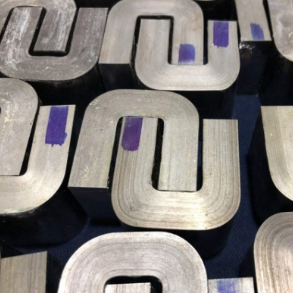
Gnee provides premium iron cores to the world. Our cores can be selected in a wide range of materials, shapes, applications, manufacturing techniques, etc., to meet customers' diverse demands. Explore our wide product range now~



Manufacturing Process

1. Raw Material Sourcing

2. Slitting

3. Punching

4. Laminating

5. Core Forming

6. testing
GNEE EC
Founded in 2008 and located in Anyang in China, Gnee Electric is a high-tech enterprise specializing in researching and manufacturing iron core products.
The company currently occupies over 20,000 square meters and employs more than 200 people, including over 80 professionals. After more than 18 years of development, we have built our own magnetic material production base and independently develope, produce, and sell various kinds of iron cores. The common types include silicon steel cores, motor cores, transformer cores, toroidal iron cores, special-shaped cores, custom cores, and others. Our cores are widely applied in different sectors including transformers, motors, mutual inductors, voltage stabilizers, welding machines, magnetic amplifiers, and instrumentation, providing diverse core solutions to global customers.

30+
Types of Products
18k+
Happy Clients
Why Choose GNEE EC?
GNEE EC was founded in 2008, which is a National High-tech Enterprise & Famous Brand Enterprise in China, developing into a professional manufacturer and supplier of high-quality iron cores.
18+
Over 18 years of success in the iron core industry;
National High-tech Enterprise & Famous Brand Enterprises in China;
200+
Over 200 employees;
The R&D team has more than 80 experienced engineers and the production team has more than 100 skilled staffs;
35+
Annual turnover up to 35 million dollor per year;
Owns many sets of highly automatic winding, annealing, and assembling machines;
1,000+
Over 1000 customers in domestic and overseas markets;
core Products are exported to more than 70 countries in the world;
Gnee Iron Core Factory Overview


Meet Our Sales Manager
"The Core of the Iron Core, the Power of Leadership" - See Our Great Decision-Makers Deeply Engaged in the Magnetic Materials Industry.

Edison Zhang
CEO

Kelly Zhang
General Manager

Alex Cao
Sales Manager
Industries Served

Automobile Industry

New Energy


Transformer Applications

Our Mission
Strive To Create world-class Iron core brand
With 18 Years of industry experience, we focus on the research, development, and manufacturing of high-quality iron cores for electricity, industrial control, new energy, and automotive markets