


The Potential Of Nanocrystalline Cores
Oct 16, 2025
Leave a message
Nanocrystalline Core
Nanocrystalline cores are made from nanocrystalline materials-think super-small crystals. These materials are engineered to have unique magnetic properties, making them ideal for various applications. Imagine a material so fine-tuned that it can significantly improve energy efficiency.
The structure and components of these cores are equally fascinating. They're typically toroidal, meaning they're shaped like a doughnut. This design minimizes energy loss, making these cores incredibly efficient. It's like having a sports car engine in the body of a compact car-high performance without the bulk.

Applications Of Nanocrystalline Cores
In Electronics
You know those transformers and inductors in your devices? Nanocrystalline cores are making them better. How? By offering superior magnetic properties that enhance energy efficiency. It's like upgrading from a regular light bulb to an LED-the same brightness, less energy.
And it's not just about energy savings. These cores also improve the performance of electronic components. They offer higher saturation magnetization and lower core loss.
Renewable Energy
Switching gears to renewable energy. Solar panels, wind turbines-you name it, nanocrystalline cores are there. These cores are crucial in converting and storing energy efficiently. Imagine a wind farm that generates more power with fewer turbines. That's the kind of efficiency we're talking about.
But why stop at wind and solar? These cores also make waves in other renewable energy sectors like hydro and geothermal. They're helping these systems reach new levels of efficiency, making renewable energy more viable than ever.
How Do Nanocrystalline Cores Work?
Let's get into the mechanics of these tiny wonders. Ever wondered what makes nanocrystalline cores tick? It's all in the material properties. Keep reading to discover the science that powers these game-changing cores.
Material Properties
Alright, let's get a bit scientific-but not too much, promise! Nanocrystalline materials are unique because of their grain structure. These grains are incredibly small, often just a few nanometers across. Small size, big impact. These tiny grains give the material some fantastic magnetic properties.
What does this mean for you? Well, if you're into tech, it's like discovering a new programming language that makes everything faster and more efficient. These materials are engineered to be the best of the best, offering properties you won't find in traditional magnetic cores.
Magnetic Behavior
So, what makes these cores magnetic marvels? It's all about how they interact with magnetic fields. Nanocrystalline cores have high permeability and low coercivity. In simpler terms, they're really good at becoming magnetized but don't hold onto that magnetism when the magnetic field is removed.
This behavior is a big deal. It means these cores are excellent for applications that require rapid changes in magnetism, like in transformers or inductors. It's like having a sprinter who can start and stop on a dime-super useful in a variety of situations.
Advantages And Disadvantages
Ready for the good news? Let's dive into the advantages of nanocrystalline cores. Trust us, the list of pros is pretty impressive. Keep reading to find out why these cores are such a big deal in the tech world.
Pros
Let's talk perks. First up, efficiency. These cores are energy-saving ninjas. They offer better energy conversion rates, meaning less waste and more output. It's like getting 15 miles per gallon more from your car-over time, that adds up.
Next, versatility. From medical devices to renewable energy, these cores are everywhere. They're the Swiss Army knife of the magnetic core world. And let's not forget durability. These cores are built to last, offering long-term performance that won't let you down.
Cons
But hey, nothing's perfect. First, the cost. Quality comes at a price, and these cores are no exception. They're an investment, but one that often pays off in the long run.
Second, complexity. These aren't your run-of-the-mill components. They require specialized manufacturing techniques, which can complicate things.
Comparing Nanocrystalline Cores With Other Cores
So, how do nanocrystalline cores stack up against other types of cores? It's time for a face-off. Keep reading as we put nanocrystalline cores in the ring with ferrite cores, amorphous cores, and silicon steel cores. First up, ferrite cores. Let's see how they compare.
Ferrite Cores
So how do nanocrystalline cores stack up against the competition? Let's start with ferrite cores. Ferrite cores are cheaper, sure, but they often lack the high performance and efficiency that nanocrystalline cores offer.
It's like comparing a standard sedan to a luxury sports car-both will get you from point A to point B, but one does it with a lot more style and speed.
Amorphous Cores
Next up, amorphous cores. These cores are also energy-efficient but tend to be less versatile than their nanocrystalline counterparts. Think of them as a specialized tool-great for certain jobs but not as flexible when your needs change.
Silicon Steel Cores
Last but not least, silicon steel cores. These are the old-school cores that have been around for ages. They're durable and reliable but lag in energy efficiency. It's like using a flip phone in the age of smartphones-it works, but you're missing out on a lot of features.
Nanocrystalline ring Core specification

| Magnetic core size(mm) | Protective box size(mm) | Effective cross-sectional area Ae(mm2) | Magnetic path length Ie(mm) | Maximum DC overcurrent class (A) |
||||||
| id | od | ht | ID | OD | HT | |||||
| 14 | 19 | 6.5 | 12 | 22 | 8 | 11.86 | 51.81 | 20 | ||
| 14 | 20 | 10 | 12 | 22.3 | 11.4 | 29.68 | 52.29 | 40 | ||
| 16 | 21 | 10 | 15 | 24 | 12.3 | 24.85 | 57.41 | 60 | ||
| 16 | 23 | 8 | 15 | 24 | 9.7 | 20.44 | 61.23 | 60 | ||
| 16 | 23 | 10 | 15 | 24 | 12.3 | 34.62 | 59.92 | 60 | ||
| 17 | 22 | 10 | 15.3 | 24.4 | 12.3 | 24.86 | 60.59 | 60 | ||
| 17 | 21 | 8 | 15.3 | 24 | 9.7 | 25.56 | 60.67 | 60 | ||
| 17 | 23 | 8 | 15.3 | 24.4 | 9.7 | 26.89 | 61.34 | 60 | ||
| 18 | 23 | 10 | 16.4 | 24.4 | 12.3 | 29.78 | 60.38 | 70 | ||
| 18 | 24 | 9 | 16.4 | 25 | 11.2 | 34.78 | 60.89 | 70 | ||
| 18 | 25 | 10 | 16.4 | 25.9 | 12.3 | 37.97 | 64.56 | 70 | ||
| 19 | 24 | 9 | 17.3 | 25 | 11.2 | 40.39 | 65.32 | 80 | ||
| 19 | 25 | 10 | 17.3 | 26 | 12.3 | 39.42 | 62.31 | 80 | ||
| 19 | 26 | 10 | 17.3 | 27.3 | 12.3 | 48.32 | 69.56 | 80 | ||
| 20 | 25 | 10 | 18.5 | 26.3 | 12.3 | 39.29 | 70.32 | 90 | ||
| 20 | 28 | 10 | 18.5 | 29 | 12.3 | 45.76 | 73.88 | 90 | ||
| 20 | 32 | 10 | 18.5 | 32.3 | 12.3 | 58.91 | 78.75 | 90 | ||
| 21 | 29 | 10 | 18.2 | 31.3 | 12.3 | 39.65 | 77.19 | 100 | ||
| 21 | 26 | 8 | 18.3 | 27.4 | 9.7 | 46.54 | 78.32 | 100 | ||
| 21 | 28 | 10 | 18.3 | 30 | 12.3 | 50.39 | 77.45 | 100 | ||
| 22 | 28 | 10 | 20.5 | 30 | 12.3 | 49.32 | 79.89 | 120 | ||
| 22 | 32 | 10 | 20.5 | 33.4 | 12.3 | 43.58 | 73.43 | 120 | ||
| 23 | 32 | 10 | 21.3 | 33.4 | 12.3 | 44.56 | 74.56 | 120 | ||
GNEE Featured Products
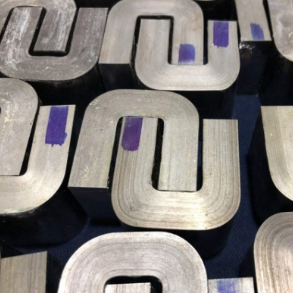
Gnee provides premium iron cores to the world. Our cores can be selected in a wide range of materials, shapes, applications, manufacturing techniques, etc., to meet customers' diverse demands. Explore our wide product range now~



Manufacturing Process

1. Raw Material Sourcing

2. Slitting

3. Punching

4. Laminating

5. Core Forming

6. testing
GNEE EC
Founded in 2008 and located in Anyang in China, Gnee Electric is a high-tech enterprise specializing in researching and manufacturing iron core products.
The company currently occupies over 20,000 square meters and employs more than 200 people, including over 80 professionals. After more than 18 years of development, we have built our own magnetic material production base and independently develope, produce, and sell various kinds of iron cores. The common types include silicon steel cores, motor cores, transformer cores, toroidal iron cores, special-shaped cores, custom cores, and others. Our cores are widely applied in different sectors including transformers, motors, mutual inductors, voltage stabilizers, welding machines, magnetic amplifiers, and instrumentation, providing diverse core solutions to global customers.

30+
Types of Products
18k+
Happy Clients
Why Choose GNEE EC?
GNEE EC was founded in 2008, which is a National High-tech Enterprise & Famous Brand Enterprise in China, developing into a professional manufacturer and supplier of high-quality iron cores.
18+
Over 18 years of success in the iron core industry;
National High-tech Enterprise & Famous Brand Enterprises in China;
200+
Over 200 employees;
The R&D team has more than 80 experienced engineers and the production team has more than 100 skilled staffs;
35+
Annual turnover up to 35 million dollor per year;
Owns many sets of highly automatic winding, annealing, and assembling machines;
1,000+
Over 1000 customers in domestic and overseas markets;
core Products are exported to more than 70 countries in the world;
Gnee Iron Core Factory Overview


Meet Our Sales Manager
"The Core of the Iron Core, the Power of Leadership" - See Our Great Decision-Makers Deeply Engaged in the Magnetic Materials Industry.

Edison Zhang
CEO

Kelly Zhang
General Manager

Alex Cao
Sales Manager
Industries Served

Automobile Industry

New Energy


Transformer Applications

Our Mission
Strive To Create world-class Iron core brand
With 18 Years of industry experience, we focus on the research, development, and manufacturing of high-quality iron cores for electricity, industrial control, new energy, and automotive markets