


The Critical Role of Transformer Cores in Energy Efficiency
Oct 23, 2025
Leave a message
Transformer cores in energy efficiency are vital to the effective operation of power distribution systems. Their primary role is to conduct magnetic flux between the primary and secondary windings, ensuring the energy transfer occurs with minimal losses. By concentrating and directing magnetic flux efficiently, these cores enhance transformer performance, reducing energy waste and boosting overall efficiency.

In addition to conducting magnetic flux, minimizing energy losses is a critical aspect of transformer cores in energy efficiency. Manufacturers can significantly reduce hysteresis and eddy current losses. This can be done by carefully selecting core materials and advanced design techniques. These losses, which generate heat and decrease efficiency, are mitigated using high-quality materials like silicon steel and precise core construction.
A well-designed transformer core also improves structural integrity and reduces noise. Ensuring reliable operation even under mechanical stress. By optimizing these aspects, manufacturers can produce high-efficiency transformers that save energy and reduce operating costs and decrease environmental impact.
Types of Transformer Cores and Their Impact on Efficiency
1. Solid core: Known for simplicity and cost-effectiveness, solid cores are often used in low-power applications like small distribution transformers. However, they typically result in higher losses and lower efficiency due to limited magnetic flux control.
2. Toroidal core: Constructed in a doughnut-shaped form, toroidal cores offer a continuous magnetic path, which minimizes magnetic leakage and reduces eddy current losses. This design is ideal for high-performance and high-efficiency transformers, where optimal energy transfer is critical.
3. Shell-type core: Featuring two cylindrical windings surrounded by a magnetic core for transformers, this design provides superior magnetic circuit continuity and reduced magnetic leakage. These characteristics make shell-type cores highly efficient, particularly in medium to high-power transformers, minimizing energy losses and ensuring reliable performance.
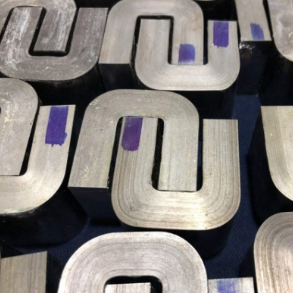
4. Wound core: These compact, lightweight cores are created by winding a magnetic strip or wire around a bobbin. Wound cores effectively control magnetic flux and reduce eddy current losses, making them suitable for high-frequency applications. They offer a balance between efficiency and size, making them a good choice for specialized transformers.
Selecting the appropriate transformer core depends on application-specific factors, including cost, size, efficiency, and performance. Understanding these trade-offs is crucial for maximizing energy efficiency in power distribution systems.
How Transformer Cores Contribute to Energy-Efficient Power Distribution
The cores of transformers play a crucial role in making power distribution more energy-efficient. Manufacturers select core materials like silicon steel and amorphous steel for their strong magnetic properties. These materials help minimize hysteresis and eddy current losses, which are two major causes of inefficiency in transformers.
Hysteresis loss occurs when the magnetic domains within the core material resist changes in magnetization. Materials like silicon steel, with low hysteresis loss, require less energy to magnetize and demagnetize, thus improving efficiency. Eddy current losses are caused by swirling currents that are induced by changing magnetic fields. Using laminated steel sheets with insulation helps reduce these losses by restricting the flow of eddy currents.
Magnetic permeability is another critical factor. It measures how easily a material can be magnetized. High-permeability materials, like certain types of iron and silicon steel, allow the magnetic field to pass through the core with minimal resistance. This further enhances transformer efficiency. By optimizing core materials and design, manufacturers can create transformers that meet strict energy efficiency standards.
Transformer Core specification
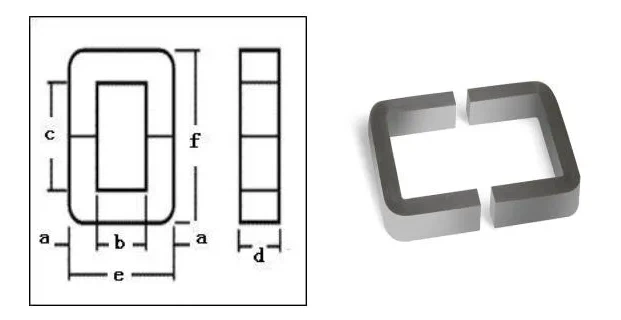
| Core Build | Window Width | Core Height | Core Width | Core Length | |||||
| a(mm) | ± | b(mm) | c(mm) | d(mm) | ± | e(mm) | ± | f(mm) | ± |
| 9 | 0.5 | 10 | 32.8 | 15 | 0.5 | 28 | 1 | 50.8 | 1.25 |
| 10 | 0.5 | 11 | 33 | 20 | 0.5 | 31 | 1 | 53 | 2 |
| 11 | 0.5 | 13 | 30 | 20 | 0.5 | 35 | 1 | 52 | 2 |
| 11 | 0.5 | 13 | 40 | 20 | 0.5 | 35 | 1 | 62 | 2 |
| 11 | 0.5 | 13 | 40 | 25 | 0.5 | 35 | 1 | 62 | 2 |
| 11 | 0.8 | 13 | 50 | 25 | 0.5 | 35 | 1 | 72 | 2 |
| 11 | 0.8 | 13 | 50 | 30 | 0.5 | 35 | 1 | 72 | 2 |
| 13 | 0.8 | 15 | 56 | 25 | 0.5 | 41 | 1 | 82 | 2 |
| 13 | 0.8 | 15 | 56 | 30 | 0.5 | 41 | 1 | 82 | 2 |
| 13 | 0.8 | 15 | 56 | 35 | 0.5 | 41 | 1 | 82 | 2 |
| 16 | 0.8 | 20 | 70 | 25 | 0.5 | 52 | 1 | 102 | 3 |
| 16 | 1 | 20 | 70 | 30 | 0.5 | 52 | 1 | 102 | 3 |
| 16 | 1 | 20 | 70 | 40 | 0.5 | 52 | 1 | 102 | 3 |
| 16 | 1 | 20 | 70 | 45 | 1 | 52 | 1 | 102 | 3 |
| 19 | 1 | 25 | 83 | 35 | 1 | 63 | 1 | 121 | 3 |
| 19 | 1 | 25 | 83 | 40 | 1 | 63 | 1 | 121 | 3 |
| 19 | 1 | 25 | 83 | 50 | 1 | 63 | 1 | 121 | 3 |
| 19 | 1 | 25 | 90 | 60 | 1 | 63 | 1 | 128 | 3 |
| 22 | 1 | 35 | 85 | 50 | 1 | 79 | 1 | 129 | 4 |
| 22 | 1 | 35 | 85 | 65 | 1 | 79 | 1 | 129 | 4 |
| 25 | 1 | 40 | 85 | 55 | 1 | 90 | 1 | 135 | 4 |
| 25 | 1 | 40 | 85 | 70 | 1 | 90 | 1 | 135 | 4 |
| 25 | 1 | 40 | 85 | 85 | 1.5 | 90 | 1 | 135 | 4 |
| 30 | 1 | 40 | 85 | 85 | 1.5 | 100 | 1 | 155 | 4 |
| 33 | 1 | 40 | 105 | 85 | 1.5 | 106 | 1 | 171 | 5 |
| Note: Additional sizes can be customized to meet specific customer requirements. | |||||||||
GNEE Featured Products
Gnee provides premium iron cores to the world. Our cores can be selected in a wide range of materials, shapes, applications, manufacturing techniques, etc., to meet customers' diverse demands. Explore our wide product range now~



Manufacturing Process

1. Raw Material Sourcing

2. Slitting

3. Punching

4. Laminating

5. Core Forming

6. testing
GNEE EC
Founded in 2008 and located in Anyang in China, Gnee Electric is a high-tech enterprise specializing in researching and manufacturing iron core products.
The company currently occupies over 20,000 square meters and employs more than 200 people, including over 80 professionals. After more than 18 years of development, we have built our own magnetic material production base and independently develope, produce, and sell various kinds of iron cores. The common types include silicon steel cores, motor cores, transformer cores, toroidal iron cores, special-shaped cores, custom cores, and others. Our cores are widely applied in different sectors including transformers, motors, mutual inductors, voltage stabilizers, welding machines, magnetic amplifiers, and instrumentation, providing diverse core solutions to global customers.

30+
Types of Products
18k+
Happy Clients
Why Choose GNEE EC?
GNEE EC was founded in 2008, which is a National High-tech Enterprise & Famous Brand Enterprise in China, developing into a professional manufacturer and supplier of high-quality iron cores.
18+
Over 18 years of success in the iron core industry;
National High-tech Enterprise & Famous Brand Enterprises in China;
200+
Over 200 employees;
The R&D team has more than 80 experienced engineers and the production team has more than 100 skilled staffs;
35+
Annual turnover up to 35 million dollor per year;
Owns many sets of highly automatic winding, annealing, and assembling machines;
1,000+
Over 1000 customers in domestic and overseas markets;
core Products are exported to more than 70 countries in the world;
Gnee Iron Core Factory Overview


Meet Our Sales Manager
"The Core of the Iron Core, the Power of Leadership" - See Our Great Decision-Makers Deeply Engaged in the Magnetic Materials Industry.

Edison Zhang
CEO

Kelly Zhang
General Manager

Alex Cao
Sales Manager
Industries Served

Automobile Industry

New Energy


Transformer Applications

Our Mission
Strive To Create world-class Iron core brand
With 18 Years of industry experience, we focus on the research, development, and manufacturing of high-quality iron cores for electricity, industrial control, new energy, and automotive markets