


Low Loss Amorphous Toroidal Core for Efficient Transformer Solutions
Oct 13, 2025
Leave a message
Amorphous Toroidal Core Product Description
Amorphous toroidal cores are a relatively newer development in the world of magnetic cores. They are made from a unique type of metal with an atomic structure that lacks long-range order, giving them different magnetic properties compared to conventional crystalline materials.
Amorphous metal cores offer several advantages over standard toroidal cores, including lower core losses, higher saturation flux density, and better temperature stability. These cores are often used in high-efficiency power supplies, inverters, and other electronic devices where reducing energy losses is a priority.

One of the standout features of amorphous alloy toroidal cores is their low core losses. This is due to the random atomic structure of the metal, which reduces eddy current and hysteresis losses within the core. As a result, amorphous cores are able to operate at higher frequencies and higher flux densities compared to their standard counterparts. This makes them particularly well-suited for applications in which energy efficiency is a key consideration.
Comparing Amorphous Toroidal Cores to Standard Toroidal Cores
When comparing amorphous toroidal cores to standard toroidal cores, one of the most significant factors to consider is core losses. Core losses, also known as iron losses, are the energy dissipated in the core material due to hysteresis and eddy currents. In transformers and inductors, core losses contribute to overall energy inefficiency and can lead to increased operating temperatures.
Standard toroidal cores, particularly those made from powdered iron, are known to have relatively high core losses. This is due to the crystalline structure of the material, which leads to significant hysteresis and eddy current losses. Ferrite cores, while offering lower core losses than powdered iron, still suffer from these energy dissipation issues.
In contrast, amorphous toroidal cores are designed to minimize core losses as much as possible. The lack of a crystalline structure in the material reduces hysteresis and eddy current losses, leading to a significant reduction in overall core losses. This makes amorphous cores a compelling choice for applications where energy efficiency is crucial, such as in renewable energy systems and electric vehicles.
Heat Dissipation and Temperature Stability
Another important consideration when comparing amorphous toroidal cores to standard toroidal cores is heat dissipation and temperature stability. In many electronic devices, particularly those operating at high frequencies or in high-power applications, controlling operating temperatures is essential to ensure long-term reliability and performance.
Standard toroidal cores, especially those made from powdered iron, can experience significant heating due to core losses. This can lead to a decrease in efficiency and can even result in thermal damage to the core material over time. Ferrite cores offer better temperature stability but may still experience temperature-related performance issues in demanding applications.
Amorphous toroidal cores, on the other hand, are known for their superior temperature stability and heat dissipation properties. The low core losses in these cores contribute to lower operating temperatures, reducing the need for additional cooling measures in the final device. This can be particularly beneficial in applications where space and weight restrictions limit the use of traditional cooling solutions.
Fluctuation in Saturation Flux Density
Saturation flux density is a crucial parameter in determining the maximum magnetic field strength a core material can withstand before it becomes magnetically saturated. In applications where the operating conditions might lead to fluctuations in magnetic flux density, it is important to consider the impact of saturation on core performance.
Standard toroidal cores, whether made from powdered iron or ferrite, have well-defined saturation flux density values. This makes it relatively easy to predict and design around the saturation behavior of these cores. However, fluctuations in operating conditions can still lead to undesirable saturation effects, particularly in high-power or high-frequency applications.
Amorphous toroidal cores offer a higher saturation flux density compared to standard cores, making them more resistant to saturation effects. This can be a significant advantage in applications where dynamic operating conditions or transient events might lead to sudden increases in magnetic flux density. Amorphous cores are able to handle these fluctuations with greater resilience, making them suitable for use in demanding and variable operating environments.
Summary
In conclusion, the choice between amorphous toroidal cores and standard toroidal cores will depend on the specific requirements of the application. Standard toroidal cores, made from powdered iron or ferrite, offer reliable performance and are well-suited for many low-frequency and medium-power applications. However, they may suffer from higher core losses, temperature stability issues, and saturation-related performance limitations.
Amorphous toroidal cores, on the other hand, present a compelling alternative with their lower core losses, superior temperature stability, and higher saturation flux density. These cores are well-suited for high-frequency, high-power, and energy-critical applications where efficiency and reliability are primary concerns. As technology continues to evolve, the choice between these two core materials will depend on the specific needs of the ever-changing electronic landscape.
ring core specification

| Magnetic core size(mm) | Protective box size(mm) | Effective cross-sectional area Ae(mm2) | Magnetic path length Ie(mm) | Maximum DC overcurrent class (A) |
||||||
| id | od | ht | ID | OD | HT | |||||
| 14 | 19 | 6.5 | 12 | 22 | 8 | 11.86 | 51.81 | 20 | ||
| 14 | 20 | 10 | 12 | 22.3 | 11.4 | 29.68 | 52.29 | 40 | ||
| 16 | 21 | 10 | 15 | 24 | 12.3 | 24.85 | 57.41 | 60 | ||
| 16 | 23 | 8 | 15 | 24 | 9.7 | 20.44 | 61.23 | 60 | ||
| 16 | 23 | 10 | 15 | 24 | 12.3 | 34.62 | 59.92 | 60 | ||
| 17 | 22 | 10 | 15.3 | 24.4 | 12.3 | 24.86 | 60.59 | 60 | ||
| 17 | 21 | 8 | 15.3 | 24 | 9.7 | 25.56 | 60.67 | 60 | ||
| 17 | 23 | 8 | 15.3 | 24.4 | 9.7 | 26.89 | 61.34 | 60 | ||
| 18 | 23 | 10 | 16.4 | 24.4 | 12.3 | 29.78 | 60.38 | 70 | ||
| 18 | 24 | 9 | 16.4 | 25 | 11.2 | 34.78 | 60.89 | 70 | ||
| 18 | 25 | 10 | 16.4 | 25.9 | 12.3 | 37.97 | 64.56 | 70 | ||
| 19 | 24 | 9 | 17.3 | 25 | 11.2 | 40.39 | 65.32 | 80 | ||
| 19 | 25 | 10 | 17.3 | 26 | 12.3 | 39.42 | 62.31 | 80 | ||
| 19 | 26 | 10 | 17.3 | 27.3 | 12.3 | 48.32 | 69.56 | 80 | ||
| 20 | 25 | 10 | 18.5 | 26.3 | 12.3 | 39.29 | 70.32 | 90 | ||
| 20 | 28 | 10 | 18.5 | 29 | 12.3 | 45.76 | 73.88 | 90 | ||
| 20 | 32 | 10 | 18.5 | 32.3 | 12.3 | 58.91 | 78.75 | 90 | ||
| 21 | 29 | 10 | 18.2 | 31.3 | 12.3 | 39.65 | 77.19 | 100 | ||
| 21 | 26 | 8 | 18.3 | 27.4 | 9.7 | 46.54 | 78.32 | 100 | ||
| 21 | 28 | 10 | 18.3 | 30 | 12.3 | 50.39 | 77.45 | 100 | ||
| 22 | 28 | 10 | 20.5 | 30 | 12.3 | 49.32 | 79.89 | 120 | ||
| 22 | 32 | 10 | 20.5 | 33.4 | 12.3 | 43.58 | 73.43 | 120 | ||
| 23 | 32 | 10 | 21.3 | 33.4 | 12.3 | 44.56 | 74.56 | 120 | ||
GNEE Featured Products
Gnee provides premium iron cores to the world. Our cores can be selected in a wide range of materials, shapes, applications, manufacturing techniques, etc., to meet customers' diverse demands. Explore our wide product range now~

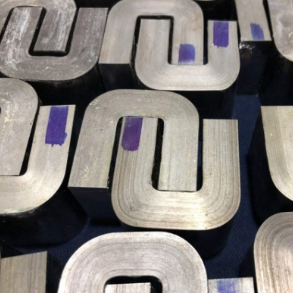


Manufacturing Process

1. Raw Material Sourcing

2. Slitting

3. Punching

4. Laminating

5. Core Forming

6. testing
GNEE EC
Founded in 2008 and located in Anyang in China, Gnee Electric is a high-tech enterprise specializing in researching and manufacturing iron core products.
The company currently occupies over 20,000 square meters and employs more than 200 people, including over 80 professionals. After more than 18 years of development, we have built our own magnetic material production base and independently develope, produce, and sell various kinds of iron cores. The common types include silicon steel cores, motor cores, transformer cores, toroidal iron cores, special-shaped cores, custom cores, and others. Our cores are widely applied in different sectors including transformers, motors, mutual inductors, voltage stabilizers, welding machines, magnetic amplifiers, and instrumentation, providing diverse core solutions to global customers.

30+
Types of Products
18k+
Happy Clients
Why Choose GNEE EC?
GNEE EC was founded in 2008, which is a National High-tech Enterprise & Famous Brand Enterprise in China, developing into a professional manufacturer and supplier of high-quality iron cores.
18+
Over 18 years of success in the iron core industry;
National High-tech Enterprise & Famous Brand Enterprises in China;
200+
Over 200 employees;
The R&D team has more than 80 experienced engineers and the production team has more than 100 skilled staffs;
35+
Annual turnover up to 35 million dollor per year;
Owns many sets of highly automatic winding, annealing, and assembling machines;
1,000+
Over 1000 customers in domestic and overseas markets;
core Products are exported to more than 70 countries in the world;
Gnee Iron Core Factory Overview


Meet Our Sales Manager
"The Core of the Iron Core, the Power of Leadership" - See Our Great Decision-Makers Deeply Engaged in the Magnetic Materials Industry.

Edison Zhang
CEO

Kelly Zhang
General Manager

Alex Cao
Sales Manager
Industries Served

Automobile Industry

New Energy


Transformer Applications

Our Mission
Strive To Create world-class Iron core brand
With 18 Years of industry experience, we focus on the research, development, and manufacturing of high-quality iron cores for electricity, industrial control, new energy, and automotive markets