


How are Nanocrystalline cores Manufactured
Oct 17, 2025
Leave a message
Nanocrystalline core
The depreciation of Nanocrystalline cores is only 30 percent that of permalloy cores and 70%-80% that of ferrite cores. As a result, transformers and inductors use far less energy. They are smaller and lighter, allowing Nanocrystalline cores to be used in more complex equipment and instruments that ferrite cores cannot.
Because of their high permeability, low power outages, and maximum saturation, Nanocrystalline cores are an excellent candidate for common mode choke (CMC) operations. Nanocrystalline transformer core standard mode chokes are widely used in applications such as solar inverters, switched-mode power supplies (SMPS), frequency converters, UPS, EMC filters, and various automotive and welding purposes.
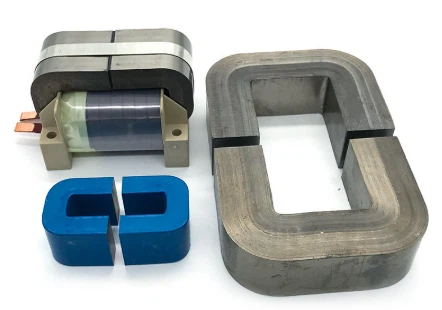
What Exactly Are Metallic Nanocrystals?
The term "soft" in magnetics refers to a magnetic material that exhibits a low coercivity, such as an alloy formed by crystallizing a Fe-based amorphous magnetic materials alloy. Nanocrystal grains are equally distributed throughout this material's amorphous (or non-crystalized) state.
At ambient temperature, this material is ferromagnetic, and when combined with nanocrystals, it achieves low saturation magnetostriction constant, making it an incredibly soft magnetic material.
Because of its superior properties compared to traditional magnetic materials, this material was primarily employed in choke coils and transformers for power electronics. Because of its remarkable properties, its components may be considerably smaller.
Advantages of Nanocrystalline cores
Several distinctive and valuable features exist in nanocrystalline materials. Nanocrystalline transformer core materials' remarkable mechanical, chemical, electrical, and quantum capabilities have spurred significant technological innovation in recent decades and are ready to drive substantially more innovations in the coming years.
1. High Power Density
Power density is several orders of magnitude higher than ferrite and amorphous alternatives. Because of their minimal propensity to alter form during magnetism, nanocrystalline transformer core materials are ideal for high-frequency applications.
2. Excellent Permeability
The most noticeable characteristic of cores is their high permeability. It coincides with the electromagnetic field's direction and may be polarized easily.
Furthermore, they boost the conductor's creation of electric motive power. The change in current flow gradually lowers the number of revolutions in the windings.
3. Minimal Core Loss
Materials create a lot of heat while interacting with magnetism. Magnetic core loss is expected when the magnetic flux in the core is changed. Nanocrystalline cores have less heat than regular cores since they reduce core loss. As a result, they are highly efficient when dealing with AC-designed motors.
4. Induction of High Saturation
They effectively reduce the component's size. This skill allows them to limit the size of their cores.
5. Coercivity is Low
Magnetic materials must have a low magnetic force resistance. When a material has a high coercivity, it isn't easy to magnetize it, and it takes a long time and a lot of power. Nanocrystalline cores have low coercivity, making magnetization simple.
6. They Have an Exceptionally High Curie Temperature
Curie temperature is the temperature at which magnetic materials change their characteristics dramatically. Because nanocrystalline materials have high curie temperatures, they can work entirely at 120 degrees.
7. Strong Heat Stability
While magnetizing, Nanocrystalline cores can generate just a tiny amount of heat. It is beneficial to the core because of the more significant the heat stability, the better the efficiency of the core. With their high heat resilience, Nanocrystalline cores have a minimal core loss.
Nanocrystalline cores Manufacturing Material
The manufacturing technique for NC samples differs significantly from that utilized for ceramic manufacture since the final core is generated by a continuous laminar structure that is wrapped.
1. Metals Used
Nickel iron and silicon iron are the most often employed metals in producing nanocrystalline toroidal core. Due to a new supplier, a master magnetic and thermal material distributor has introduced a comprehensive range of amorphous cores, bespoke Nanocrystalline cores, and 80% nickel-iron alloy cores to its inventory.
2. Amorphous Ribbon
The amorphous ribbon has the benefit of not having crystalline structures like other magnetic materials since amorphous metals do not. Because the atoms in an amorphous metal are randomly organized, its resistivity is approximately three times that of its crystalline equivalent.
Amorphous alloys are created by cooling the melt at a rate of around 1 million degrees per second.
3. Fundamental Core Substances
Toroid, gapped toroid, cut cores, and specialized stampings are among the core configurations. With the inclusion of these items, it is now possible to offer competitive rates on low-frequency magnetics designs in addition to the high-frequency magnetics designs it previously supported.
4. Nanocrystalline Ribbon
The nanocrystalline ribbon comprises Fe, Si, and B with Nb and Cu additions. Just like an amorphous ribbon, it is created by a quick cooling procedure into a thin ribbon that is initially amorphous and then crystallized in a second heat treatment at 500-600 degrees Celsius.
This produces a microstructure with tiny grain sizes of 10 nanometers, thus the term nanocrystalline.
5. Amorphous Cores with Air Gaps
Amorphous choke cores in standard, and bespoke sizes with plastic casings, epoxy coating, or varnish impregnated are among the configurations and applications supplied. The amorphous cut cores come in typical ACC sizes and bespoke designs.
Choke coils are an everyday use. Amorphous choke cores with air gaps are also available in standard and bespoke sizes, with plastic casings, epoxy coating, or varnish coated.
Decreased magnetic component volume, high relative permeability values, and stable operation at high temperatures are all advantages of iron-based nanocrystalline materials. These characteristics are defined mainly by the production procedure.
The Procedure
· The composition has a two-phase structure of an ultra-fine grain phase of FeSi embedded in a 7-25 micrometer thick amorphous ribbon.
· The core material is melted by heating it to 1300 °C and then placing it on a water-cooled wheel, which cools it to 20 °C.
· The resulting amorphous metal ribbon is annealed in the presence of transverse and longitudinal magnetic fields.
· As a result of this treatment, the magnetic properties change, and the amorphous structure generates ultrafine crystals with typical sizes ranging from 7 to 20 nm, resulting in the nanocrystalline material.
· The final stage in this process is to apply a protective coating or plastic housing to safeguard the obtained cores from the tape's brittleness.
Nanocrystalline Toroidal core specification

| Magnetic core size(mm) | Protective box size(mm) | Effective cross-sectional area Ae(mm2) | Magnetic path length Ie(mm) | Maximum DC overcurrent class (A) |
||||||
| id | od | ht | ID | OD | HT | |||||
| 14 | 19 | 6.5 | 12 | 22 | 8 | 11.86 | 51.81 | 20 | ||
| 14 | 20 | 10 | 12 | 22.3 | 11.4 | 29.68 | 52.29 | 40 | ||
| 16 | 21 | 10 | 15 | 24 | 12.3 | 24.85 | 57.41 | 60 | ||
| 16 | 23 | 8 | 15 | 24 | 9.7 | 20.44 | 61.23 | 60 | ||
| 16 | 23 | 10 | 15 | 24 | 12.3 | 34.62 | 59.92 | 60 | ||
| 17 | 22 | 10 | 15.3 | 24.4 | 12.3 | 24.86 | 60.59 | 60 | ||
| 17 | 21 | 8 | 15.3 | 24 | 9.7 | 25.56 | 60.67 | 60 | ||
| 17 | 23 | 8 | 15.3 | 24.4 | 9.7 | 26.89 | 61.34 | 60 | ||
| 18 | 23 | 10 | 16.4 | 24.4 | 12.3 | 29.78 | 60.38 | 70 | ||
| 18 | 24 | 9 | 16.4 | 25 | 11.2 | 34.78 | 60.89 | 70 | ||
| 18 | 25 | 10 | 16.4 | 25.9 | 12.3 | 37.97 | 64.56 | 70 | ||
| 19 | 24 | 9 | 17.3 | 25 | 11.2 | 40.39 | 65.32 | 80 | ||
| 19 | 25 | 10 | 17.3 | 26 | 12.3 | 39.42 | 62.31 | 80 | ||
| 19 | 26 | 10 | 17.3 | 27.3 | 12.3 | 48.32 | 69.56 | 80 | ||
| 20 | 25 | 10 | 18.5 | 26.3 | 12.3 | 39.29 | 70.32 | 90 | ||
| 20 | 28 | 10 | 18.5 | 29 | 12.3 | 45.76 | 73.88 | 90 | ||
| 20 | 32 | 10 | 18.5 | 32.3 | 12.3 | 58.91 | 78.75 | 90 | ||
| 21 | 29 | 10 | 18.2 | 31.3 | 12.3 | 39.65 | 77.19 | 100 | ||
| 21 | 26 | 8 | 18.3 | 27.4 | 9.7 | 46.54 | 78.32 | 100 | ||
| 21 | 28 | 10 | 18.3 | 30 | 12.3 | 50.39 | 77.45 | 100 | ||
| 22 | 28 | 10 | 20.5 | 30 | 12.3 | 49.32 | 79.89 | 120 | ||
| 22 | 32 | 10 | 20.5 | 33.4 | 12.3 | 43.58 | 73.43 | 120 | ||
| 23 | 32 | 10 | 21.3 | 33.4 | 12.3 | 44.56 | 74.56 | 120 | ||
GNEE Featured Products
Gnee provides premium iron cores to the world. Our cores can be selected in a wide range of materials, shapes, applications, manufacturing techniques, etc., to meet customers' diverse demands. Explore our wide product range now~

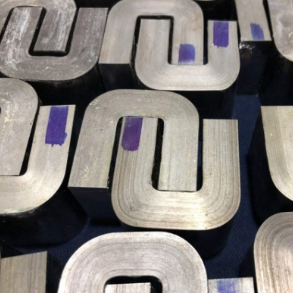


Manufacturing Process

1. Raw Material Sourcing

2. Slitting

3. Punching

4. Laminating

5. Core Forming

6. testing
GNEE EC
Founded in 2008 and located in Anyang in China, Gnee Electric is a high-tech enterprise specializing in researching and manufacturing iron core products.
The company currently occupies over 20,000 square meters and employs more than 200 people, including over 80 professionals. After more than 18 years of development, we have built our own magnetic material production base and independently develope, produce, and sell various kinds of iron cores. The common types include silicon steel cores, motor cores, transformer cores, toroidal iron cores, special-shaped cores, custom cores, and others. Our cores are widely applied in different sectors including transformers, motors, mutual inductors, voltage stabilizers, welding machines, magnetic amplifiers, and instrumentation, providing diverse core solutions to global customers.

30+
Types of Products
18k+
Happy Clients
Why Choose GNEE EC?
GNEE EC was founded in 2008, which is a National High-tech Enterprise & Famous Brand Enterprise in China, developing into a professional manufacturer and supplier of high-quality iron cores.
18+
Over 18 years of success in the iron core industry;
National High-tech Enterprise & Famous Brand Enterprises in China;
200+
Over 200 employees;
The R&D team has more than 80 experienced engineers and the production team has more than 100 skilled staffs;
35+
Annual turnover up to 35 million dollor per year;
Owns many sets of highly automatic winding, annealing, and assembling machines;
1,000+
Over 1000 customers in domestic and overseas markets;
core Products are exported to more than 70 countries in the world;
Gnee Iron Core Factory Overview


Meet Our Sales Manager
"The Core of the Iron Core, the Power of Leadership" - See Our Great Decision-Makers Deeply Engaged in the Magnetic Materials Industry.

Edison Zhang
CEO

Kelly Zhang
General Manager

Alex Cao
Sales Manager
Industries Served

Automobile Industry

New Energy


Transformer Applications

Our Mission
Strive To Create world-class Iron core brand
With 18 Years of industry experience, we focus on the research, development, and manufacturing of high-quality iron cores for electricity, industrial control, new energy, and automotive markets