


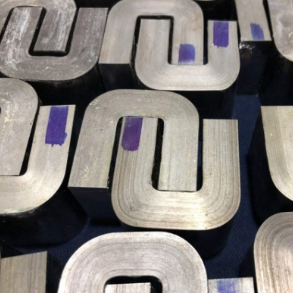
1K107 Rectangle Nanocrystalline Core for Efficient Transformers
Oct 28, 2025
Leave a message
Nanocrystalline cores offer a superior combination of high permeability, high saturation flux density, and low core loss compared to amorphous cores and traditional materials like ferrite and silicon iron. Nanocrystalline cores excel in high-frequency applications like EMC filters and power supplies, providing higher efficiency and smaller sizes due to their low energy losses and high saturation flux density. Amorphous cores are often preferred for low-frequency, high-efficiency applications like power distribution transformers, while traditional materials can be a cost-effective alternative for less demanding applications.

Nanocrystalline cores vs. Amorphous cores
Nanocrystalline:
- Best for: High-frequency applications, high-power handling, and high saturation flux density.
- Advantages: Higher saturation flux density than amorphous cores, leading to smaller component sizes. They also have better thermal stability and higher curie temperatures, making them suitable for higher operating temperatures.
- Disadvantages: Can be more expensive than amorphous cores. They can also be susceptible to saturation in certain high-current applications without proper design.
Amorphous:
- Best for: Low-frequency, high-efficiency applications where low core loss is the top priority.
- Advantages: Very low core losses compared to traditional materials.
- Disadvantages: Lower saturation flux density compared to nanocrystalline cores, meaning larger core sizes for a given power handling capability.
Nanocrystalline cores vs. Traditional materials
Nanocrystalline:
- Best for: High-frequency applications where efficiency and size are critical.
- Advantages: Much higher permeability, lower core losses, and higher saturation flux density than ferrite and silicon iron. This allows for smaller components, lower turns of wire, and higher efficiency.
- Disadvantages: Higher initial cost compared to silicon iron.
Traditional materials:
- Ferrite:
Best for: High-frequency applications where high permeability is not the primary concern.
Advantages: Cost-effective for certain applications.
Disadvantages: Lower permeability and higher core losses compared to nanocrystalline cores, especially at higher frequencies. Lower curie temperature.
- Silicon iron:
Best for: Low-frequency, cost-sensitive applications where size is not a major constraint.
Advantages: Lower material cost.
Disadvantages: Higher core losses, especially at higher frequencies, compared to amorphous and nanocrystalline materials.
Key properties of Rectangle Nanocrystalline Core
- High permeability: Increases inductance and reduces the number of turns needed, leading to smaller components.
- High saturation flux density: Allows for smaller core sizes for a given power rating.
- Low core loss: Reduces energy consumption and heat generation.
- High curie temperature: Enables operation at higher temperatures without performance degradation.
- Low magnetostriction: Results in lower audible noise.
Nanocrystalline Core specification

| CORE DIMENSION | |||
| OD(mm) | ID(mm) | L(mm) | H(mm) |
| 28 | 12 | 60 | 10 |
| 35 | 22 | 90 | 18 |
| 40 | 25 | 92 | 15 |
| 42 | 25 | 95 | 15 |
| 45 | 28 | 100 | 20 |
| 50 | 28 | 120 | 20 |
| 65 | 35 | 125 | 20 |
| 70 | 45 | 143 | 25 |
| 80 | 58 | 135 | 25 |
| 95 | 70 | 146 | 25 |
| 124 | 100 | 268 | 25 |
| 130 | 100 | 310 | 25 |
| 160 | 124 | 350 | 25 |
| 180 | 145 | 385 | 25 |
| 200 | 175 | 435 | 25 |
| 210 | 180 | 410 | 25 |
| 255 | 215 | 470 | 25 |
| Note: Additional sizes can be customized to meet specific customer requirements. | |||
GNEE Featured Products
Gnee provides premium iron cores to the world. Our cores can be selected in a wide range of materials, shapes, applications, manufacturing techniques, etc., to meet customers' diverse demands. Explore our wide product range now~



Manufacturing Process

1. Raw Material Sourcing

2. Slitting

3. Punching

4. Laminating

5. Core Forming

6. testing
GNEE EC
Founded in 2008 and located in Anyang in China, Gnee Electric is a high-tech enterprise specializing in researching and manufacturing iron core products.
The company currently occupies over 20,000 square meters and employs more than 200 people, including over 80 professionals. After more than 18 years of development, we have built our own magnetic material production base and independently develope, produce, and sell various kinds of iron cores. The common types include silicon steel cores, motor cores, transformer cores, toroidal iron cores, special-shaped cores, custom cores, and others. Our cores are widely applied in different sectors including transformers, motors, mutual inductors, voltage stabilizers, welding machines, magnetic amplifiers, and instrumentation, providing diverse core solutions to global customers.

30+
Types of Products
18k+
Happy Clients
Why Choose GNEE EC?
GNEE EC was founded in 2008, which is a National High-tech Enterprise & Famous Brand Enterprise in China, developing into a professional manufacturer and supplier of high-quality iron cores.
18+
Over 18 years of success in the iron core industry;
National High-tech Enterprise & Famous Brand Enterprises in China;
200+
Over 200 employees;
The R&D team has more than 80 experienced engineers and the production team has more than 100 skilled staffs;
35+
Annual turnover up to 35 million dollor per year;
Owns many sets of highly automatic winding, annealing, and assembling machines;
1,000+
Over 1000 customers in domestic and overseas markets;
core Products are exported to more than 70 countries in the world;
Gnee Iron Core Factory Overview


Meet Our Sales Manager
"The Core of the Iron Core, the Power of Leadership" - See Our Great Decision-Makers Deeply Engaged in the Magnetic Materials Industry.

Edison Zhang
CEO

Kelly Zhang
General Manager

Alex Cao
Sales Manager
Industries Served

Automobile Industry

New Energy


Transformer Applications

Our Mission
Strive To Create world-class Iron core brand
With 18 Years of industry experience, we focus on the research, development, and manufacturing of high-quality iron cores for electricity, industrial control, new energy, and automotive markets