

How does the thickness of Crgo Silicon Steel affect its performance?
Jul 24, 2026
Leave a message
Cold Rolled Grain-Oriented (CRGO) silicon steel is a key material in the electrical industry, widely used in transformers, motors, and other electrical equipment. As a leading supplier of CRGO silicon steel, I often encounter questions from customers about how the thickness of this material affects its performance. In this blog post, I will delve into this topic and provide insights to help you make informed decisions when selecting the appropriate thickness for your applications.
1. Basics of CRGO Silicon Steel
CRGO silicon steel is a special type of electrical steel that has a highly oriented grain structure. This orientation is achieved through a complex manufacturing process, including cold rolling and annealing, which results in excellent magnetic properties in the rolling direction. The addition of silicon to the steel helps to reduce core losses and increase electrical resistivity, making it an ideal material for electrical applications where energy efficiency is crucial.

2. Impact of Thickness on Magnetic Properties
2.1 Core Losses
Core losses are one of the most important performance indicators of CRGO silicon steel. They consist of hysteresis losses and eddy current losses. Hysteresis losses occur due to the reversal of the magnetic field in the material, while eddy current losses are caused by the induced currents in the steel.
Effect of Thickness on Eddy Current Loss in CRGO Silicon Steel
The thickness of CRGO silicon steel has a significant influence on eddy current losses. According to the classical eddy‑current loss formula:

where:
Pe = eddy current loss (W/kg or W/m³),
ke = material‑dependent constant,
f= frequency of the alternating magnetic field (Hz),
B = peak magnetic flux density (T),
t = thickness of the steel sheet (mm),
ρ= electrical resistivity of the material (Ω·m).
Since the eddy current loss is proportional to the square of thickness (Pe∝t2), any increase in sheet thickness leads to a quadratic rise in losses. Conversely, thinner CRGO steel grades exhibit substantially lower eddy current losses, which directly improves the energy efficiency of transformers and other electromagnetic devices.
For example, our 27QG095 Grain-Oriented Steel with a relatively thin thickness offers excellent low core loss performance, making it suitable for high - efficiency transformers where minimizing energy consumption is a top priority.
2.2 Magnetic Permeability
Magnetic permeability is a measure of how easily a material can be magnetized. In general, the thickness of CRGO silicon steel has a minor impact on its magnetic permeability in the rolling direction. However, for thicker sheets, there may be some non - uniformities in the magnetic field distribution within the material, which can slightly affect the overall magnetic performance. Thinner sheets tend to have a more uniform magnetic field distribution, resulting in more stable magnetic permeability.
3. Influence on Mechanical Properties
3.1 Flexibility and Formability
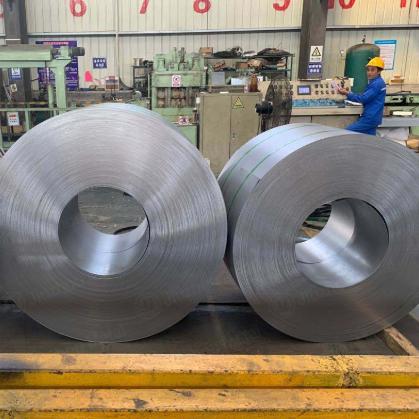
Thinner CRGO silicon steel sheets are more flexible and easier to form into various shapes. This is particularly important in applications where the steel needs to be bent, coiled, or cut into specific geometries. For example, in the production of small - sized transformers or motors, the ability to form the steel into complex shapes is crucial. Our Cold Rolled Oriented Silicon Steel Coil with a suitable thin thickness can be easily processed, reducing the manufacturing cost and improving production efficiency.
3.2 Tensile Strength and Brittleness
As the thickness of CRGO silicon steel increases, its tensile strength generally increases. However, thicker sheets may also be more brittle. This brittleness can pose challenges during handling and processing, as there is a higher risk of cracking or breaking. Therefore, when choosing the thickness, it is necessary to balance the requirements for mechanical strength and formability.

4. Thermal Performance
The thickness of CRGO silicon steel also affects its thermal performance. Thicker sheets have a larger heat - storage capacity, which can be beneficial in some applications where heat dissipation is not a critical issue. However, in high - power electrical equipment, excessive heat accumulation can lead to a decrease in performance and even damage to the equipment. Thinner sheets, on the other hand, have a lower heat - storage capacity but a higher surface - to - volume ratio, which allows for more efficient heat transfer.
In large - scale transformers, for instance, the use of thinner CRGO silicon steel sheets can help to improve thermal management, ensuring the stable operation of the equipment over a long period of time. Our 27Q130 30Q120 Grain Oriented Silicon Steel Core is available in different thicknesses, allowing customers to select the most appropriate option based on their specific thermal requirements.
5. Cost Considerations
The thickness of CRGO silicon steel also has an impact on cost. Thinner sheets generally require more precise manufacturing processes, which can increase the production cost. However, the lower core losses and better energy - saving performance of thinner sheets can offset the higher initial cost in the long run. On the other hand, thicker sheets are usually less expensive to produce but may result in higher energy consumption during the operation of electrical equipment.
Therefore, when making a decision on the thickness of CRGO silicon steel, it is necessary to consider the overall cost - effectiveness, taking into account both the initial procurement cost and the long - term operating cost.
6. Applications and Recommended Thickness
Different applications have different requirements for the thickness of CRGO silicon steel.
6.1 Power Transformers
Power transformers are one of the most common applications of CRGO silicon steel. For large - scale power transformers with high power ratings, thinner sheets (such as 0.23 mm - 0.27 mm) are often used to reduce core losses and improve energy efficiency. Our 27QG100 Grain Oriented Silicon Steel Sheet is a popular choice for this type of application.
6.2 Distribution Transformers
Distribution transformers are usually smaller in size and have relatively lower power ratings. In this case, a slightly thicker sheet (around 0.30 mm - 0.35 mm) can be used to balance the cost and performance.
6.3 Small Motors and Generators
For small motors and generators, thinner sheets are preferred due to their better formability and lower core losses. Sheets with a thickness of 0.18 mm - 0.23 mm are commonly used in these applications.
Conclusion
As a supplier of CRGO Silicon Steel, I understand the importance of selecting the right thickness for different applications. The thickness of CRGO silicon steel affects its magnetic properties, mechanical properties, thermal performance, and cost. By carefully considering these factors, you can choose the most suitable thickness to optimize the performance and cost - effectiveness of your electrical equipment.
If you are in the market for CRGO silicon steel and need further assistance in selecting the appropriate thickness for your specific application, please feel free to contact us for a detailed consultation. Our team of experts is ready to provide you with professional advice and high - quality products.
References
- "Magnetic Materials and Their Applications" by E. C. Snelling
- "Electrical Engineering Materials" by A. R. Jha